|
...
 Radau�s
personal lens instantly brings together a great variety of things
within its frame, as if it were a multi-faceted crystal ball. The
image which she presents does not refer to a specific period in time
whatsoever. It spontaneously opens ajar the doors to all times.
Therefore, the visual logic which we come across in her images does
not appear in overlapping forms, but is juxtaposed, and is constantly
repeated. The framework of the image stretches out into time, leaning
against these side by side reflections of life. Radau�s
personal lens instantly brings together a great variety of things
within its frame, as if it were a multi-faceted crystal ball. The
image which she presents does not refer to a specific period in time
whatsoever. It spontaneously opens ajar the doors to all times.
Therefore, the visual logic which we come across in her images does
not appear in overlapping forms, but is juxtaposed, and is constantly
repeated. The framework of the image stretches out into time, leaning
against these side by side reflections of life.
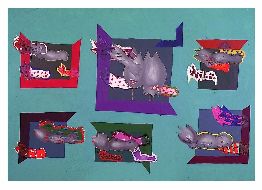
One is invoked by a sense of
history at the sight of these images. However, this is
more of
a
reminiscence,
rather than a sense of being besieged. For the method she employs is
not an affirmation of the historical information, but simply an
attempt to build a bridge between the past and the present. Through
vivid references to the reality of man in the ever flowing and
fascinating whirlpool of time, she points out at the fact that
dissatisfactions and all kinds of ravaging acts are not, indeed,
unfamiliar to us.
...
HUSAMETTIN KOCAN, 1991
...
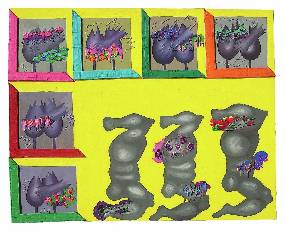 Ever
since her first appearance at �H�samettin Ko�an�s Studio�exhibition in
1990, Z�mr�t Y. Radau has been marked as an artist willing to
experience new things and always going beyond her limits. In her works,
she tries to balance her innate vividness with the grayness of her
human figures. These human figures inspired from ancient sculptures
are remoulded in Radau�s hands, so as to bear new implications. Space
and time are vitally important for Radau. Splitting her canvas into
frames, she also displays an attitude typical to that of museum
curators; sifting through the layers of time and space, she eventually
ends up in our present day. Ever
since her first appearance at �H�samettin Ko�an�s Studio�exhibition in
1990, Z�mr�t Y. Radau has been marked as an artist willing to
experience new things and always going beyond her limits. In her works,
she tries to balance her innate vividness with the grayness of her
human figures. These human figures inspired from ancient sculptures
are remoulded in Radau�s hands, so as to bear new implications. Space
and time are vitally important for Radau. Splitting her canvas into
frames, she also displays an attitude typical to that of museum
curators; sifting through the layers of time and space, she eventually
ends up in our present day.
...
NUR NIRVEN, 1992
...
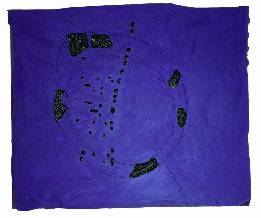 Z�mr�t
Y. Radau�s exhibition at AKM (Feb. 4, 1997) can be described as an
attempt to put forth her personal language; she pays homage to artists
whom she has been inspired of. While establishing her own utterance,
or parole, she also sends a greeting to artists who have contributed
in forming her subjectivism. Setting out from their works, Radau
constructs her own parole. This personal language emerges as a
language which has become �anonymous� begins to bear traces of her own.
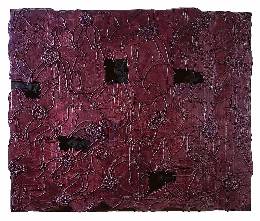
Radau employs one of the main elements of archaeology, the tumulus, as
a means of exposing her personal language. These are flat mounds of
earth artificially piled over the remnants of ancient settlements. And
Radau uses this artificiality on her canvases, fully aware of its
fakeness. She uses five-centimeter foam boards, or styrofoams on the
canvas to make up the layers, which are then pierced by soldering iron,
and installs her mounds on this surface. The cavities are brought into
being through a meticulous Z�mr�t
Y. Radau�s exhibition at AKM (Feb. 4, 1997) can be described as an
attempt to put forth her personal language; she pays homage to artists
whom she has been inspired of. While establishing her own utterance,
or parole, she also sends a greeting to artists who have contributed
in forming her subjectivism. Setting out from their works, Radau
constructs her own parole. This personal language emerges as a
language which has become �anonymous� begins to bear traces of her own.
Radau employs one of the main elements of archaeology, the tumulus, as
a means of exposing her personal language. These are flat mounds of
earth artificially piled over the remnants of ancient settlements. And
Radau uses this artificiality on her canvases, fully aware of its
fakeness. She uses five-centimeter foam boards, or styrofoams on the
canvas to make up the layers, which are then pierced by soldering iron,
and installs her mounds on this surface. The cavities are brought into
being through a meticulous
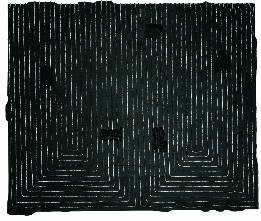 working
of the overlapping mounds, treated as though they were black holes.
Thus, the artist not only puts her need for historical layers on
artificial grounds, but also tries to find her own space amidst these
layers of time. As we know, mounds love plains and are, therefore,
rarely found under the geographical conditions prevailing beyond the
Balkans and in South Europe. Central Anatolia provides a
geographically prolific means for the formation of mounds. By carrying
contemporary art masters to the Anatolian geography, Radau not only
reinforces the relation between singularity and universality, but also
tries to pull the domain of Turkish contemporary art to these areas. working
of the overlapping mounds, treated as though they were black holes.
Thus, the artist not only puts her need for historical layers on
artificial grounds, but also tries to find her own space amidst these
layers of time. As we know, mounds love plains and are, therefore,
rarely found under the geographical conditions prevailing beyond the
Balkans and in South Europe. Central Anatolia provides a
geographically prolific means for the formation of mounds. By carrying
contemporary art masters to the Anatolian geography, Radau not only
reinforces the relation between singularity and universality, but also
tries to pull the domain of Turkish contemporary art to these areas.
...
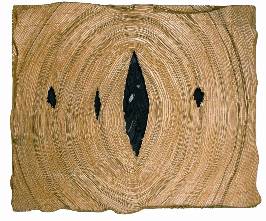 Z�mr�t
Radau presents us with a mixed technique displayed in the form of
mounds, while seeking her own way through eulogies addressed to
artists she�s been inspired of. That�s why mounds play a crucial role.
Their influences are each taken as a quotation, appearing as fourteen
125x 150 and one 160x 200 canvases. They wink at the elements of
contemporary art works ranging from Matisse to Fontana, to Boltanski,
Christo, Klein, Warhol etc., from their artificial mounds. While
carrying the parole of Tumuli to our present day, Z�mr�t Radau brings
us face to face with her own collective subjectivism. Putting aside
the deceitfulness of an effort to consider herself as an individual,
in her works, she takes on the burden of exploring how collective
subject is achieved in art. In order to point this out, she also takes
proper care to wholly use the artificiality of the mounds which make
up contemporary art and Z�mr�t
Radau presents us with a mixed technique displayed in the form of
mounds, while seeking her own way through eulogies addressed to
artists she�s been inspired of. That�s why mounds play a crucial role.
Their influences are each taken as a quotation, appearing as fourteen
125x 150 and one 160x 200 canvases. They wink at the elements of
contemporary art works ranging from Matisse to Fontana, to Boltanski,
Christo, Klein, Warhol etc., from their artificial mounds. While
carrying the parole of Tumuli to our present day, Z�mr�t Radau brings
us face to face with her own collective subjectivism. Putting aside
the deceitfulness of an effort to consider herself as an individual,
in her works, she takes on the burden of exploring how collective
subject is achieved in art. In order to point this out, she also takes
proper care to wholly use the artificiality of the mounds which make
up contemporary art and
 the
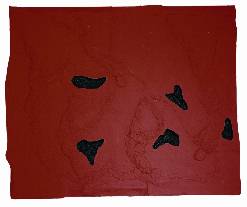
tumuli. On her canvases personal language searches itself a field of
existence within time. For Stella�s spirals she uses ropes; for
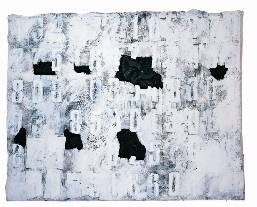
Fontana�s cavities she digs holes on the foam board; in Warhol�s Coca
Cola images she handles the serigraphy on cloth; the muscles in
Matisse�s dance are made of seaweeds to give a better reflection of
their impact. And by the
tumuli. On her canvases personal language searches itself a field of
existence within time. For Stella�s spirals she uses ropes; for
Fontana�s cavities she digs holes on the foam board; in Warhol�s Coca
Cola images she handles the serigraphy on cloth; the muscles in
Matisse�s dance are made of seaweeds to give a better reflection of
their impact. And by
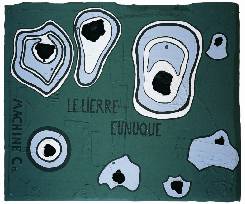
 combining
Boltanski�s shadow plays (Monsters) with Karag�z, the Turkish shadow
theatre tradition, she tries to give spirit to the essence of the
mounds. As if opposing to the
distinction between matter and its spirit, she doesn�t abstain from
mixing material with shadowy spirits. The mounds she uses to form her
personal language always keeps us reminding that the language is
formed by the other, by others. While scattering her own existence,
the artist brings forth her personal language and shows that she can
only find herself a place in here. She prefers artists to interrogate
their own languages, rather than the way that art history points out
at us. Realizing that utterance borders on language, through her
mounds she makes us see what is unhiddenly �visible� among the layers
of this border. combining
Boltanski�s shadow plays (Monsters) with Karag�z, the Turkish shadow
theatre tradition, she tries to give spirit to the essence of the
mounds. As if opposing to the
distinction between matter and its spirit, she doesn�t abstain from
mixing material with shadowy spirits. The mounds she uses to form her
personal language always keeps us reminding that the language is
formed by the other, by others. While scattering her own existence,
the artist brings forth her personal language and shows that she can
only find herself a place in here. She prefers artists to interrogate
their own languages, rather than the way that art history points out
at us. Realizing that utterance borders on language, through her
mounds she makes us see what is unhiddenly �visible� among the layers
of this border.
...
ALI AKAY, 1997
Z�mr�t Y. Radau finds it extremely surprising that an artist should
penetrate into tha microcosmos of
 another
and interferes with this inavitable state of affairs, thus her
painting reveals a process of work which culminates in the exhibition
entitled �Quotations�. Though such an interference does not raquire,
in my opinion, that the artistshould go through a series of
predetermined actions that are devised (meticulously) beforehand. The
artist, rather tries to exhibit an inventory of momentary inclinations,
instead of rational choises. This is by no means incorrect. For that
other criterion that this �choise� would determine the anteriority or
posteriority of these works of art which we are presented only through
their physical appearance (at least what seems to be their physical
appearance?) The artist, spinning a memory for herself, is bound to
weave this �network� knotting together the loops in a random pattern
(no doubt). Though random, these loops are of vital importance. This
highly resembles the decision that a mollusk ought to make in taking
�the first step� to built its shell� another
and interferes with this inavitable state of affairs, thus her
painting reveals a process of work which culminates in the exhibition
entitled �Quotations�. Though such an interference does not raquire,
in my opinion, that the artistshould go through a series of
predetermined actions that are devised (meticulously) beforehand. The
artist, rather tries to exhibit an inventory of momentary inclinations,
instead of rational choises. This is by no means incorrect. For that
other criterion that this �choise� would determine the anteriority or
posteriority of these works of art which we are presented only through
their physical appearance (at least what seems to be their physical
appearance?) The artist, spinning a memory for herself, is bound to
weave this �network� knotting together the loops in a random pattern
(no doubt). Though random, these loops are of vital importance. This
highly resembles the decision that a mollusk ought to make in taking
�the first step� to built its shell�
�
Z�mr�t Y. Radau�s works reveal a
thorough questioning of the problematic of history. The artist is not
interested in the historical stance of the artists she has named (Andy
Warhol, Yves Klein,  Frank
Stella, Jasper Johns, Christian Boltansky, etc.) she is concerned
about her �actual� position. As she digs these works out of the soil,
she becomes aware of the fact that they have undergone a change and
she cannot help being (as I have already emphasized in the first
sentences of this review) surprised.The works of each artist has
probably merged with another, the consepts mixed together and united
and the forms deformed. Is it possible that there are some fragments
still left intact? If so, within the framework of such a deformation
how have they been able to preserve themselves intact? This question Frank
Stella, Jasper Johns, Christian Boltansky, etc.) she is concerned
about her �actual� position. As she digs these works out of the soil,
she becomes aware of the fact that they have undergone a change and
she cannot help being (as I have already emphasized in the first
sentences of this review) surprised.The works of each artist has
probably merged with another, the consepts mixed together and united
and the forms deformed. Is it possible that there are some fragments
still left intact? If so, within the framework of such a deformation
how have they been able to preserve themselves intact? This question
 cannot
be explained clearly, either.However, one thing that is clear is,
these artworks that were left undergroud, hidden in the soil (the soil
is the specific area belonging to Z�mr�t Y. Radau and each
interference to any of these works has always been realized by her)
for years are at this point quite far away from their �starting point
or that first step�. Neither is it possible anymore to talk about the
�originality� of these works of art that have been torn apart from
their starting point. They have transferred their reality into their
actual appearance at specific this time and place. Something that
comes back in time or something that has been realized over again has
nothing to do with the authentic. The copy has even changed the model
through its different qualities. cannot
be explained clearly, either.However, one thing that is clear is,
these artworks that were left undergroud, hidden in the soil (the soil
is the specific area belonging to Z�mr�t Y. Radau and each
interference to any of these works has always been realized by her)
for years are at this point quite far away from their �starting point
or that first step�. Neither is it possible anymore to talk about the
�originality� of these works of art that have been torn apart from
their starting point. They have transferred their reality into their
actual appearance at specific this time and place. Something that
comes back in time or something that has been realized over again has
nothing to do with the authentic. The copy has even changed the model
through its different qualities.
...
EMRE ZEYTINOGLU, 1997
 We
freguently come across the image of the flower in Z�mr�t Y. Radau�s
paintings. We
freguently come across the image of the flower in Z�mr�t Y. Radau�s
paintings. In
her homage
paintings to Van Gogh, Matisse, Rousseau or O�Keeffe, the flower
is one of the elements she uses to reflect the world of
these artists.It is a
repetitive image that appears as a background motif in her paintings
where
the artist discovers and transforms, re-interprets and looks through
fresh eyes to the artists of the past.when she�s interpreting artists
that can be associated with certain flowers, like Van Gogh and his
sunflowers for example, Z�mr�t Y. Radau uses flowers to set the stage
and play a In
her homage
paintings to Van Gogh, Matisse, Rousseau or O�Keeffe, the flower
is one of the elements she uses to reflect the world of
these artists.It is a
repetitive image that appears as a background motif in her paintings
where
the artist discovers and transforms, re-interprets and looks through
fresh eyes to the artists of the past.when she�s interpreting artists
that can be associated with certain flowers, like Van Gogh and his
sunflowers for example, Z�mr�t Y. Radau uses flowers to set the stage
and play a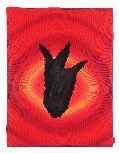 game of reading the past.
...
The paintings of the �Tulip Period�
signal to a slight change in the way Z�mr�t Y. Radau constructs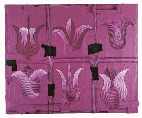 pictorial space. Actually, as before, she transforms her canvas into a
kind of wall-sculpture, or a visual object rather than a painting, by
juxtaposing thick, heavy and full surfaces on top of each other, layer
upon layer, like a construction of metaphorical time. But she creates
a space that is more contained within
pictorial space. Actually, as before, she transforms her canvas into a
kind of wall-sculpture, or a visual object rather than a painting, by
juxtaposing thick, heavy and full surfaces on top of each other, layer
upon layer, like a construction of metaphorical time. But she creates
a space that is more contained within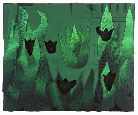 itself with the same elements
and technique; and instead of those paintings that create a space
within a space and capture the spectator�s imagination
trough different forms, motifs and so-called tumulus structures spread
over
the canvas (and thus creating impression of a city in ruins,as
H�samettin Ko�an has pointed out), we are faced with a collection of
paintings that can be perceived all at once and in all their entirety.
The colours in this series are generally deep and shady; even the most
lively colours carry a �dark� effect, as if there was an intuitive
agreement between the artist and her palette. itself with the same elements
and technique; and instead of those paintings that create a space
within a space and capture the spectator�s imagination
trough different forms, motifs and so-called tumulus structures spread
over
the canvas (and thus creating impression of a city in ruins,as
H�samettin Ko�an has pointed out), we are faced with a collection of
paintings that can be perceived all at once and in all their entirety.
The colours in this series are generally deep and shady; even the most
lively colours carry a �dark� effect, as if there was an intuitive
agreement between the artist and her palette.
AHU ANTMEN, 2000
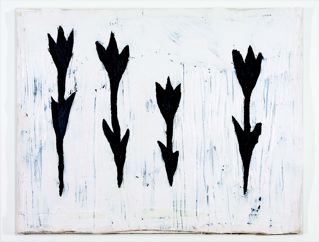
Radau has quoted primarily from the second half of the 20th
century artists, and that these quotes serve to enhance the
predominant Radau concept of time and that these quotes merge
harmoniously with the tulips. In this exhibition the artist makes
references to the works of Lucio Fontana, Alberto Burri, Jasper Johns,
Gilbert&George, Anish Kapoor, Cy Twombly. Here sometimes Fontana�s
torn figures turn into Radau�s tulips, sometimes as in her artwork
that reminds one of Gilbert&George style, she cuts up those tulip
photos that she herself has taken into smaller pieces to stick on the
canvass that has been divided into squares. And at other times those
tulip paintings that she has cut out of the canvass becomes subjects
themselves. Another aspect of these paintings is the recurrence of
tumuluses �an element we frequently come across in her earlier
paintings� from time to time as if by accident. This in a way means
that her earlier paintings are subtly being added to the present ones,
as a time layer. I believe that at this point we should remember that
Radau also quoted one of her own paintings in her last exhibition. The
artist in this last exhibition titled �Tulipa� has informed us that in
her paintings of later periods the tulip figure has formed a mid layer
and has stated that she has perceived the art works created during
last five years as a time as if by accident. This in a way means
that her earlier paintings are subtly being added to the present ones,
as a time layer. I believe that at this point we should remember that
Radau also quoted one of her own paintings in her last exhibition. The
artist in this last exhibition titled �Tulipa� has informed us that in
her paintings of later periods the tulip figure has formed a mid layer
and has stated that she has perceived the art works created during
last five years as a
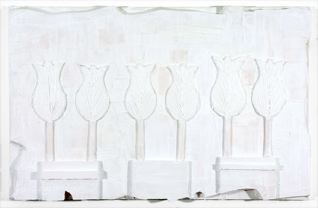 time layer. Beginning with this she has moved on
to create a series where she
used quotations taken from her own paintings: �Homage to Tulip Period�
series consist of groups made up of four, six or eight paintings each
making a reference to a previous painting from �The Tulip Period�.
Z�mr�t Radau just as she places quotes taken from artists she has
chosen as time layers in her paintings, she also makes quotes from her
own works thus placing her artistic past, her artistic memory in her
paintings to act as a time layer. By carrying the past into the
present she actually takes us to another concept: postproduction. time layer. Beginning with this she has moved on
to create a series where she
used quotations taken from her own paintings: �Homage to Tulip Period�
series consist of groups made up of four, six or eight paintings each
making a reference to a previous painting from �The Tulip Period�.
Z�mr�t Radau just as she places quotes taken from artists she has
chosen as time layers in her paintings, she also makes quotes from her
own works thus placing her artistic past, her artistic memory in her
paintings to act as a time layer. By carrying the past into the
present she actually takes us to another concept: postproduction.
...
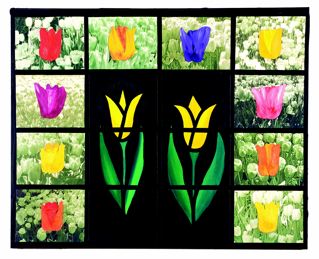 Z�mr�t
Radau has also created postproduction art work by using those
canvasses where she utilized her reminiscences of the great masters,
using quotations, adjacencies, contingencies and thus making the final
canvass something altogether independent of its original model. Just
as in a novel, a short story or an essay using completely different
methods, creates different meanings than the texts it takes quotes,
the same can be applied to a work of art. The painting may remind the
viewer of its model, having meaningful associations but it must
diversify and go down a totally different road. Here the artist takes
up a new stand regarding the model, putting a distance between her and
her model, and directs her model to a different direction than its
essence, diverts it. Z�mr�t
Radau has also created postproduction art work by using those
canvasses where she utilized her reminiscences of the great masters,
using quotations, adjacencies, contingencies and thus making the final
canvass something altogether independent of its original model. Just
as in a novel, a short story or an essay using completely different
methods, creates different meanings than the texts it takes quotes,
the same can be applied to a work of art. The painting may remind the
viewer of its model, having meaningful associations but it must
diversify and go down a totally different road. Here the artist takes
up a new stand regarding the model, putting a distance between her and
her model, and directs her model to a different direction than its
essence, diverts it.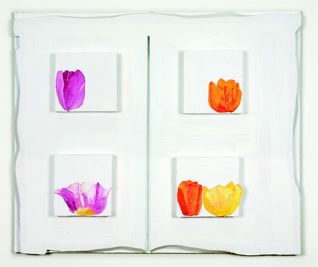 Postproduction that brings out a situationist practice, in other words
an act of diversion, is based on diverting the essence by
appropriating it. As in the �pisoir� example of Duchamp, facts like
the social being carried over to the area of art within the
particularity of capitalist codes of production, decontextualization
of objects, in our day art is carrying itself towards the social arena
of production, opening up its horizons to the social areas through
documentary art and references to the history of art. Bourriaud
maintains that art constructs its relation with the world using signs,
forms and gestures and that this is another kind of economy, because
here the artist creates some sort of a relation between human beings
or objects. And Z�mr�t Radau is forming these relationships by her
quotations; those relations between the past and present...
Postproduction that brings out a situationist practice, in other words
an act of diversion, is based on diverting the essence by
appropriating it. As in the �pisoir� example of Duchamp, facts like
the social being carried over to the area of art within the
particularity of capitalist codes of production, decontextualization
of objects, in our day art is carrying itself towards the social arena
of production, opening up its horizons to the social areas through
documentary art and references to the history of art. Bourriaud
maintains that art constructs its relation with the world using signs,
forms and gestures and that this is another kind of economy, because
here the artist creates some sort of a relation between human beings
or objects. And Z�mr�t Radau is forming these relationships by her
quotations; those relations between the past and present...
BURCU PELVANO�LU, 2010
|

